Lesson 4: Trend & Market Structure
This refers to how markets move over time, whether they are trending up, down or stuck in a sideways channel. You can really help your decision making by selecting stocks in the right structure.

Why this matters?
This really deals with how markets actually move over time. Most losses come from fighting the market.
People often act on emotions are against the prevailing trend. They:
-
Buy because something “looks cheap”
-
Sell because something “feels high"
Market structure stops that!
If you understand structure, you stop guessing and start aligning. Trading with the trend is so much easier than trying to guess reversal areas or just thinking - "the price has gone down 50 or 60%, it has to bounce soon". There's no doubt you can trade reversals, and there's a strategy that we love which does exactly that, but it has to be around structure - not a hope or a gut feeling.
This looks cheap doesn't it?
It's Aston Martin, and it's down 90% from it's IPO in October 2018. By June 2020 it was trading at around £5 having traded at £45 at launch. But then it falls another 90%. So thinking £5 must have been a bargain, 90% of your investment is gone! Don't ignore the structure. You can trade these type of stocks, but you cannot hold a stock like this. It will ruin you. Great cars (if you like that sort of thing) - terrible investment.
What market structure really means?
Market structure is simply trying to deal with how price moves from one decision point to the next.
Those decision points create:
-
Highs
-
Lows
-
Trends
-
Ranges
This structure is the framework everything else sits on.
The three structural states
All markets cycle between three states:
1. Uptrend
-
Higher highs
-
Higher lows
-
Pullbacks are opportunities, not threats
The market is rewarding buyers. We're looking for longs (to buy) and potential hold stocks for longer term moves. This is the FTSE 100 - trading above the 21 and 50 moving averages.
2. Downtrend
-
Lower highs
-
Lower lows
-
Rallies are opportunities for sellers
The market is punishing holders and price moves down. Don't hold if your market is in a structural bear market. The below chart shows the EURUSD on a daily time frame - it fails to push through the 50 EMA for over 1.5 years - no point trying to find longs here if you're looking for a a trend higher.
3. Range
-
No clear progression
-
Price oscillates between levels
-
Breakouts attract attention - most fail
Patience matters most here and you don't have to be in the market. Depending on your strategy, you can sit tight. Cash can be a position when managing your wealth. This is Tesla back in the early days. It's tests the hights a few times before dropping back into the range. Then bursts higher.
Higher highs and lower lows
Forget perfection. Structure is about direction, not symmetry or catching the exit price levels for your entry, target or stop loss.
An uptrend does not need:
-
Equal pullbacks
-
Clean angles
-
Pretty charts
There's a technical framework called Elliott Wave. This can be helpful but it requires some deeper technical ability in our view. Rather, lets keep this more simple and look for markets that are in clear uptrends or downtrends.
Pullback vs reversal
This is where people get it wrong.
Pullback
-
Happens within a trend
-
Respects prior structure
-
Volume usually contracts - at least that's what provide the context for a strong potential breakout.
Pullbacks reset momentum and allow the stock to consolidate, and continue the move.
Reversal
-
Breaks structure
-
Changes behaviour
-
Often messy and volatile
Reversals are harder to trade than trends. If you can catch reversals that then create the start of new directional moves, they're extremely profitable, but it might take a few attempts to enter.
Breaks and change of structure
There's a guide or framework we like to use here at FoundryStrat which breaks the market down into 4 core phases or stages. It's based on Stan Weinstein's great book Secrets for Profiting in Bull and Bear Markets. It's is a must read. Weinstein described markets moving through four repeating stages:
Stage 1 – Basing
-
Price moves sideways
-
Volatility contracts
-
Smart money accumulates quietly
Nothing looks exciting here. That’s the point. Like the Tesla example above.
Stage 2 – Advancing
-
Structure turns upward
-
Breakouts start to hold
-
Pullbacks become buying opportunities
This is where most of the money is made. There are ways to identify a break out from stage 1 into stage 2 where we look to buy a market and stay 'long'.
Stage 3 – Topping
-
Momentum slows and volume can rise on down days
-
Ranges widen out and the market doesn't push higher - it's stuck
-
Breaks of structure start appearing - topping patterns form including:
-
Double tops
-
Head and shoulders
-
ABC corrections
-
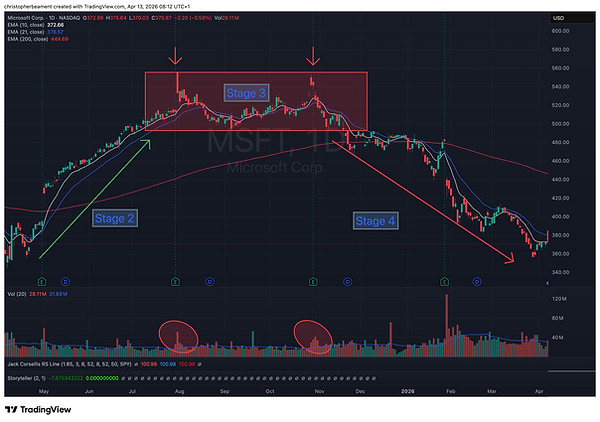
Look at the below double top from Microsoft. There's a volume spike at each of the highs within that stage. Price sells off from each high on high volume. It breaks that range and doesn't recover, dropping away into stage 4....
And then one break becomes two and you're into stage four 4...
Stage 4 – Declining
-
Structure rolls over
-
Rallies fail
-
Selling pressure dominates
Capital preservation matters most here.
Why this framework still works
Stan Weinstein's book is fairly old now. He wrote it originally in 1988. Markets have changed. Human behaviour hasn’t and that's the key point. We can go back to the early 1900s and we still see these exact chart patterns playing out. The companies and industries might have been different, but human behaviour was the same. Look at William O'Neil's classic How To Trade In Stocks. the first hundred pages of that book are charts from over 100 years ago and you see these same characteristics.
Weinstein’s stages aren’t about prediction, they’re about recognition. You can use this framework to stop trying to pick turning points and start responding to evidence.
The key takeaway
You don’t need to call the top or bottom. We see so many of our followers and clients trying to catch falling knives - ie. price has fallen or is in freefall. A stock looks cheaper, but there could well be something more sinister going on. In every day human life, something that's cheaper, generally represents better value. But that isn't the case in stock markets.
You need to recognise:
-
When the market is healthy
-
When it’s deteriorating
-
And when it’s hostile
One break gets your attention. Two breaks change your behaviour. That mindset alone keeps you on the right side of most markets.
Multi-timeframe structure
Especially if you're going to trade on smaller time frames, you must look at the larger time frame.
-
Weekly = big picture
-
Daily = execution context
-
Intraday = precision - but only if you're ready for day trading. We don't recommend that for beginners.
Rule of thumb:
Trade in the direction of the higher timeframe structure.
This alone filters out bad trades.
Why trends last longer than expected
Trends persist because:
-
Positioning builds slowly
-
Big money can’t move quickly
-
Psychology changes in phase
Structure keeps you on the right side!
Common structure mistakes
Avoid:
-
Calling tops in strong uptrends
-
Buying bottoms in downtrends
-
Forcing structure where none exists
If you have to convince yourself, it’s not there.
A simple structure checklist
Before acting, ask:
-
What is the higher timeframe trend?
-
Has structure been broken?
-
Is this a pullback or a reversal?
-
Am I trading with or against pressure?
If you’re against pressure, reduce size or step aside.
What’s next?
Now that you understand structure, the next step is learning how to support decisions without clutter.
That means indicators - used properly! We don't use many but there are some handy ones!