
Spring has Sprung
- Apr 1
- 4 min read
Three spring trade setups on the radar
There’s a seasonal pun in here, but more importantly, there’s also our favourite market setup.
A lot of spring-style setups are appearing after the volatility surrounding the Iranian situation. .

For us at FoundryStrat, the spring is one of the cleanest ideas in the Wyckoff playbook. It is simple in theory, but powerful in practice. Price undercuts a prior low or range low, shakes people out, traps weak hands and then pushes back up through the level. That reclaim is the key. It is the market telling you the breakdown did not stick.
It is one of our favourite setups because it gives you a clear line in the sand. If the reclaim holds, you can be involved. If it fails, you know where you are wrong.
Note that you're allowed two days where the market can be below the prior low, it must then bounce back above that low, otherwise it's invalid. It's better if it pops straight back the following day. Here are three examples that we see setting up.
1. Nvidia – the straightforward spring

This is pretty textbook. The market sold off, pushed below the prior range low, and then quickly bounced back above it. That is exactly what you want to see in a spring setup. It still takes two days but the third day close is back above. A break of support that sucks in sellers, followed by a recovery that leaves them on the wrong side.
Entry on the break of the green candle and stop below. Once the price reclaims the 21 EMA, we can look to move to trailing stop and sell into strength.
The move below the low creates the fear. The move back above it creates the opportunity.
In Wyckoff terms, that is the shakeout. In trading terms, it is the market saying the path lower was not accepted. Nvidia gave that message clearly.
2. Vertiv – similar shape, same principle, quick retake
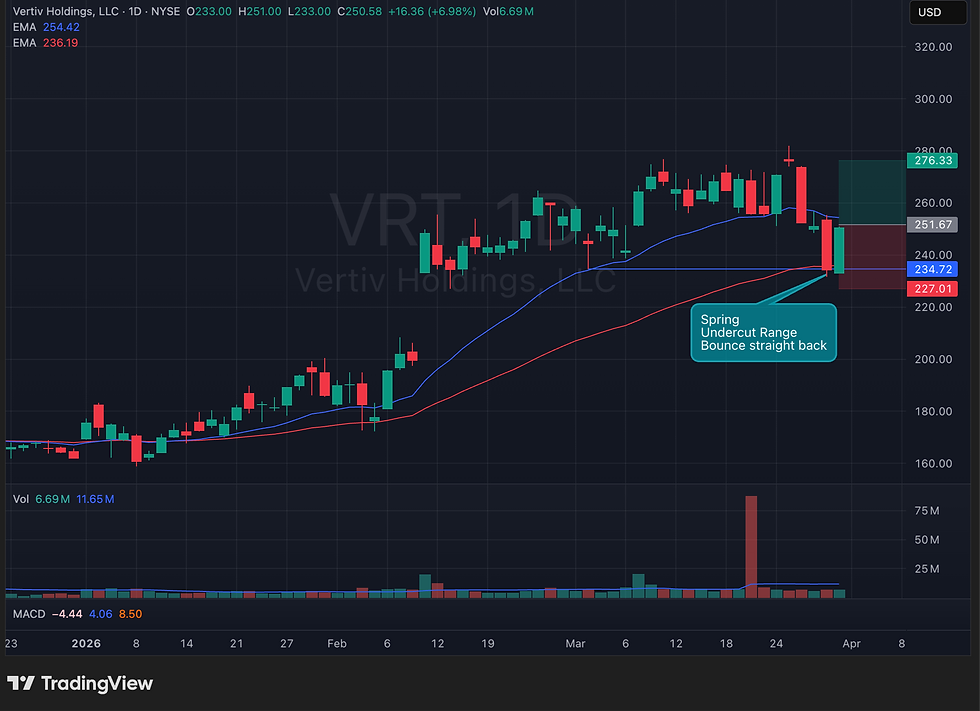
Vertiv had a very similar feel because it's trending up and now in a new range. It feels like it's consolidating within the uptrend. Again, price undercuts the low of the range and then snapped back. It was not complicated. It did not need to be. The best setups often are not. We also liked that it snapped straight back and didn't have to wait another day like NVDA above.
The appeal of this type of trade is that the market gives you a defined point of invalidation. You are not guessing in the middle of nowhere. You are working with a failed break lower and a reclaim of an important area. That is what makes the setup attractive.
Lets remember, this doesn't guarantees upside. Nothing does. But because the risk can be defined and the setup is clear: Break the level. Reclaim the level. React to that information.
3. CoreWeave – messier, but still tradable
CoreWeave is the untidiest of the three. See if you can follow it.
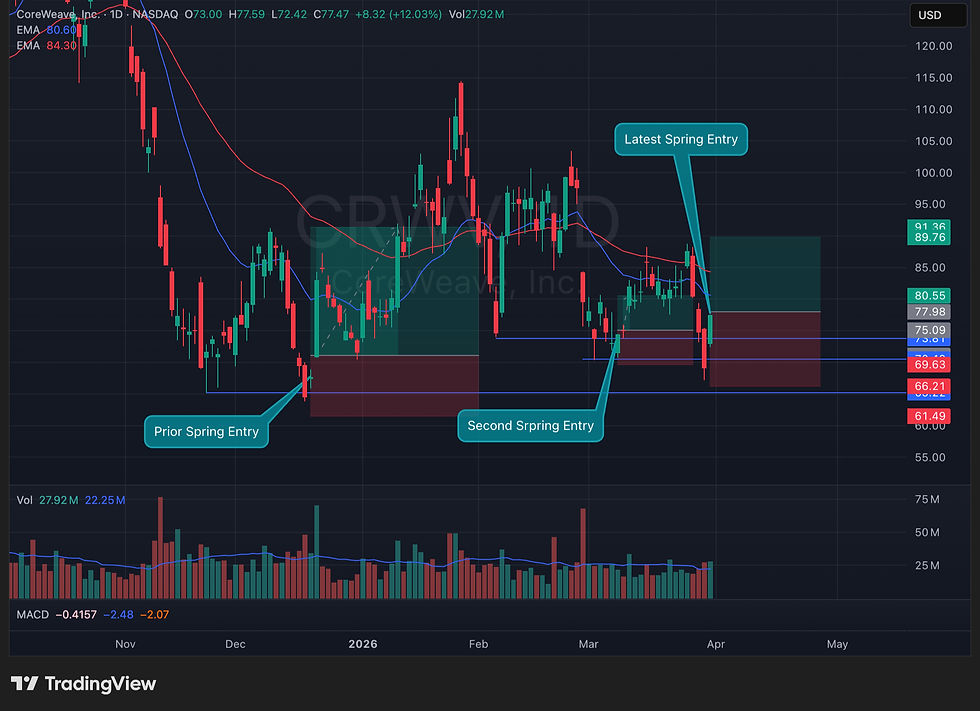
It is not a perfect textbook spring. There have already been a couple of prior spring-style entries and the structure is noisier. But this is real trading, not a textbook. Charts are often messy. Setups often come with imperfections. That is where a bit of judgement comes in.
The important point here is that the prior two spring attempts were still workable. They may not have exploded higher, but they would still have offered either a profit or at worst a scratch to slightly positive outcome if managed properly. That matters. A setup does not need to become a huge winner to be valid. Sometimes the edge is simply that the trade gives you a good risk-reward profile and does not punish you badly when it fails.
That is part of the FoundryStrat approach.
We are not looking for perfection. We are looking for repeatable patterns where risk can be controlled and where the market gives us enough evidence to act.
CoreWeave fits that description, even if it needs a little more creative licence than Nvidia or Vertiv.
As usual, once they've played out, we'll revisit and review so you can learn from these examples.
Why the spring matters
The reason we like springs so much is that they sit right at the point of emotional pressure.
Support breaks. People panic. Stops get triggered. The big players step in to take up liquidity. Then price reclaims the level and the whole picture changes. That is classic Wyckoff behaviour.
The market flushes out weak holders, absorbs supply and then attempts to move higher. You are effectively trading the failure of the breakdown, not just buying a dip. That distinction matters. Buying weakness blindly is not the same as waiting for weakness to fail.
Final point – manage risk
One final point. Lots of spring setups are starting to appear because we might be at a low post recent volatility and the issues in Iran are showing signs of easing.
But this is still a market being pushed around by headlines, especially around the Trump's Truth Social posts. That means volatility can stay elevated and moves can reverse quickly. So even when the setup looks good, risk management still comes first. That means smaller sizing where needed. Clear stops. No hero trades. No assuming that because one spring worked, they all will.
The setup gives you the opportunity. Risk management keeps you in the game long enough to use it.
Comments