
Turning £10,000 into £214,000 in 6 years: LQQ3 Trading Strategy
- May 27
- 4 min read
There are two ways to look at leveraged ETFs. The first is the usual warning label: they are dangerous, volatile, and can move against you very quickly.
That is true. But the second view is more interesting....
Used with a clear process, defined rules and disciplined exits, leveraged products can become powerful vehicles for systematic trading. This LQQ3 strategy is a good example.
LQQ3 is the GBP-listed version of the 3x leveraged Nasdaq 100 ETP. In simple terms, it is designed to give around three times the daily movement of the Nasdaq 100. That leverage cuts both ways. When the market trends in your favour, the compounding can be exceptional. When it moves against you, losses can build quickly.
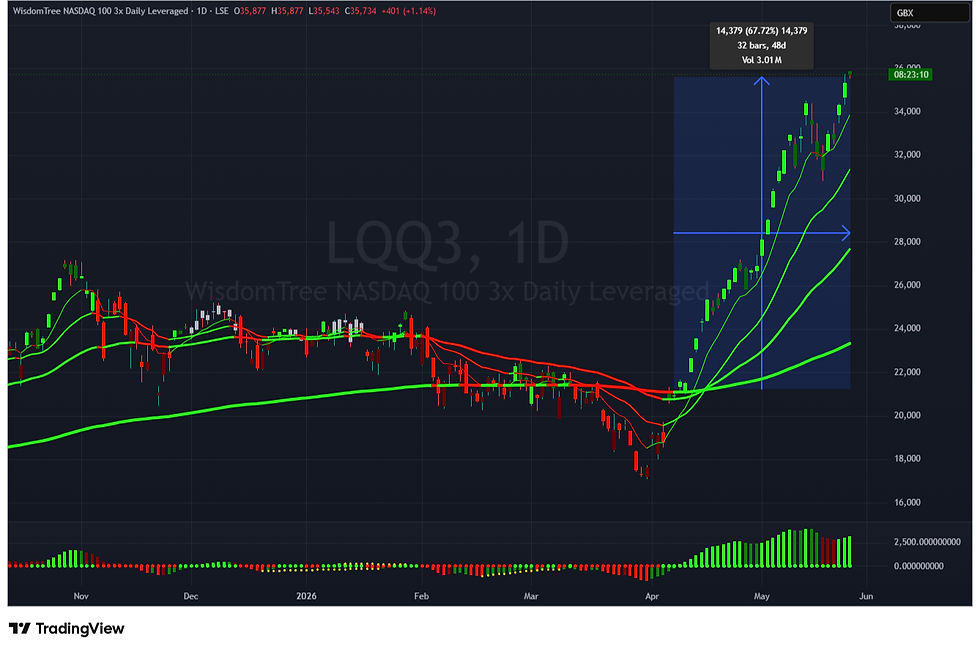
That is why the rules matter. The below chart shows the recent run up in the Nasdaq with a trading system imbedded which is a simple buy on green candle, sell on red candle. The latest move is currently up nearly 68% while the 'standard' Nasdaq would be up around 28% from a similar entry point.
The Strategy
The system is not trying to predict the economy, forecast interest rates or guess what Nvidia will do next quarter.
It is much simpler than that. The strategy waits for a defined buy signal, enters the trade, and then exits when the sell condition is triggered.
The aim is to capture the stronger trending phases in the Nasdaq while avoiding some of the larger drawdown periods. This is not buy and hold (although that can work with this strategy which we've written about here.
It is not trying to sit through every 20%, 30% or 50% decline. It is trying to participate when the trend is favourable and step aside when the signal turns.
The Backtest
The test started with £10,000 on 28 October 2019. Why then? before this point, the ETF data (LQQ3) became a little patchy and pricing data was less reliable. Just to say - we're not cherry picking.
By 20 May 2026, the strategy had grown to approximately:
£214,161
That is a total return of:
+2,041.6%
Or put another way:
21.4x the starting capital
The annualised return over the period was approximately:
59.5% per annum
That is an extraordinary number. But it needs to be understood properly. This is a leveraged strategy. The returns are not coming from magic. They are coming from three things working together:
A powerful underlying market
A leveraged instrument
A rules-based system that avoided some of the worst periods.
Without the third point, the first two can become very dangerous. the drawdown was a whopping 40% so you need to be careful. This was in the 2022 bear market where it was very difficult to catch onto a trend. The system was however significantly in profit by that point so didn't actually fall below its starting balance.
Trade Statistics
Across the test period, there were 40 trades.
The strategy produced:
Metric | Result |
Starting capital | £10,000 |
Ending capital | £214,161 |
Total return | +2,041.6% |
Multiple | 21.4x |
Annualised return | 59.5% p.a. |
Number of trades | 40 |
Winning trades | 23 |
Losing trades | 17 |
Hit rate | 57.5% |
Average winning trade | +24.5% |
Average losing trade | -8.1% |
Average trade | +10.7% |
Geometric average per trade | +8.0% |
The hit rate is interesting. This strategy did not need to win 80% or 90% of the time. It only won 57.5% of trades.
That is important because many traders obsess over win rate. The real question is not: “How often are you right?”
The better question is:
“How much do you make when you are right, and how much do you lose when you are wrong?”
In this case, the average winner was around +24.5%, while the average loser was around -8.1%.
That is the engine of the strategy. The winners were roughly three times the size of the losers.
The Power of Asymmetry
A good trading strategy does not need to be right all the time. It needs positive asymmetry. That means the gains from the winners need to outweigh the damage from the losers.
This is where trend-following style systems can become powerful. They accept small and medium losses, but when the market starts trending properly, they stay involved long enough to benefit.
That is especially important with LQQ3. Because the product is leveraged, a strong trend can compound extremely quickly. But the same leverage means you cannot afford to be casual with risk. The system needs a clear exit.
Without an exit, LQQ3 can become brutal.
Why LQQ3 Works Well for This Type of System
The Nasdaq is naturally trend-driven. It is dominated by large growth and technology companies, and when momentum builds, it can run hard for long periods. Add 3x leverage to that, and the moves become amplified.
That is the attraction but it is also the danger so you have to be careful with this - don't forget about the position in your account. You may come back to a nasty drawdown. You must also think about position sizing as with any trading strategy or standalone trade. This should be allocated a small amount of your pot.
The Big Lesson
The headline number is obviously eye-catching. Turning £10,000 into more than £214,000 is the sort of return that grabs attention.
But the more useful lesson is not the final number. The useful lesson is the process. The strategy had losing trades. It had false starts. It had periods where it would have felt uncomfortable. But the rules gave it structure.
That is the difference between a trading system and a trading idea.
Final Thought
The best strategies are usually simple. Not easy.
This LQQ3 system is a reminder that you do not need to predict every market move. You need a process that gets you involved when the odds are favourable, gets you out when the signal changes, and keeps you from making emotional decisions in the middle.
That is what FoundryStrat is built around. Not prediction. Not opinion. Rules, discipline and execution. Because in trading, the aim is not to be clever. The aim is to survive long enough for the edge to compound.
If you're interested in the system itself, stay tuned, we'll talk about the exact criteria in coming updates.
Comments